Monday, May 10, 2010

Creationism vs. Evolution (feat. AronRa)

AronRaNormally I find creation/evolution debates a waste of time and effort, but in particular, one YouTube user AronRa has always been very interesting to follow. Having watched his highly provoking 15 Foundational Falsehoods of Creationism, I thought it would be very interesting to see someone try to take him on in an argument. He just recently finished an ongoing debate at the League of Reason Forums which I will link here. (You can start at the beginning of the thread if you really want to, but this position is where he links to in his profile page so I'll do the same as well.)

If you have the time to read it, I think you'll enjoy it. If you disagree you'll be challenged and if you do agree, I'm sure you'll get some kind of chuckle out of it.

Thursday, May 6, 2010

Putting the "Pro" in Programming

http://images01.tzimg.com/cache/h3w4/500_1185829253_8424.jpg
I think programming is an art. There, I said it. I've come out of my conceited little arrogant and ignorant box. Writing code that works well and is human readable is a form of art. Now before you open your mouth to disagree (or roll your eyes because you don't care), let's agree on a few terms:

art

–noun
1.
the quality, production, expression, or realm, according to aesthetic principles, of what is beautiful, appealing, or of more than ordinary significance.
2.
the class of objects subject to aesthetic criteria; works of art collectively, as paintings, sculptures, or drawings: a museum of art; an art collection.
9.
skill in conducting any human activity: a master at the art of conversation.
(Dictionary.com)
Now I do have to admit, that definition is rather inclusive. Under this line of thinking, almost anything can be an art. What I want to emphasize about programming, however, is its shared characteristics with other accepted forms of art such as paintings and music.

In paintings and music, the artist has some theme, some concept in their head that they want to convey to the audience. They want the audience to feel it and in some abstract way, interact with it. They start from scratch and work their way up, step by step, until they have their final product. Painters may brush a large background color onto the canvas, stroke a few outlines for a face, fill it with a natural color, and ultimately converge on a Mona Lisa. Musicians may lay down a rhythmic beat, record a guitar, and overlay that with vocals - all the while refining their melodies and little tweaks such as fades and mutes.

Programming is very similar. The artist here (yes) wants to write software to fill a particular need in his or someone else's life. He knows what he wants the end product to be but hasn't filled in all of the gaps yet. He must first carefully plan the approach he wants to take to solve his problems. He starts by perhaps writing a main method that contains some variables and executes some debug code. He may then create some classes and divert the program flow into a state machine or constantly run a loop that checks what it should be doing at any given time. Eventually, he will have all the necessary functions, switches, and flow controls to call his program complete. Like a work of art, it must be aesthetically pleasing. While it's definitely true that many programs are just plain ugly, I can think of quite a few examples of fluid and natural interfaces that make using that program ten times more enjoyable.

And while speaking on the topic of aesthetics, let's not forget the code itself. There are varying degrees of ugly and I'm sure I've seen a lot of them. But I've also seen good designs through creativity and good language features that turn vomit-on-sights to sparkling, wonderful breaths of fresh air. Let me give a very simple example. In C, you might have to do something like this to check the contents of a list:


Now that's just nasty. It took eight lines of code that all look like they just rolled out of bed - mussed hair, bad breath and all. It looks like garbage, and you probably wrote at least one mistake in it carelessly that you'll either notice before you compile or notice later when your outputs aren't what you expect. Conversely, you can use languages like C# that allow you to use predicates and lambda functions on wrappered lists to do operations much more quickly and easily without sacrificing readability:


 In the same way that some art is more compelling than others, so too is some software more usable and better looking than others. We can't all hit home runs every time, but we shouldn't be afraid of stepping up to the plate. We should be open to new ideas that may save us some time or complexity or frustration. We shouldn't be afraid of rewriting bad code, changing a note at the end of the second verse, or slightly changing the color of the sky to match the palette we chose. It might be painful to correct mistakes, but it's often worth it in the end.

Art or not, writing better code is important because someday, someone will have to look at the code you write and it's always a pain having to clean the monitor screen after someone's head explodes.

Monday, May 3, 2010

You're Not Really an Atheist

I've heard it said quite a few times, "You're not really an atheist. You know God exists! You just don't want to admit it and be accountable." This is usually followed by quoting, "The fool says in his heart there is no God."  Or, better yet,
Because that which may be known of God is manifest in them; for God hath shewed it unto them. For the invisible things of him from the creation of the world are clearly seen, being understood by the things that are made, even his eternal power and Godhead; so that they are without excuse: Because that, when they knew God, they glorified him not as God, neither were thankful; but became vain in their imaginations, and their foolish heart was darkened.
A little bit wordier, but the same idea. It sounds like a classic case of somebody who believes so strongly in their god that they can't fathom anyone else not believing (for whatever reasons convince them). And it's really tough (and sometimes impossible) to convince them otherwise. Maybe it's because they believe the bible, and if everything the bible says is true and if the bible says I really do believe, then I must believe. Now wouldn't that just be convenient.

I've known a lot of people that really wanted to believe (and I'm not excluding myself) but ultimately gave up their faith for logical reasons. This is admittedly rare, probably partially due to the fact that it's tough to get reasoned out of a position you didn't reach with reason in the first place. But it happens, and often enough that I'm not completely discouraged. It's tough to explain how someone could go from being a fundamentalist conservative evangelical Christian or Muslim to atheist if they really knew a God existed. But it definitely happens. Perhaps some religious people only see what they want to see.

Though I have to wonder, what exactly was Paul talking about when he mentioned the "things that are made"? Is he referring to the earth or the universe or Jesus or unicorns or what? I don't buy the Argument from Design for various reasons and that seems to be what's being pushed here. "Don't you know that every watch has a watchmaker?" the writer asks. Yes, actually, I do know that. I know that watchmakers exist and I know the explanation for how a watch gets into my hands. I also know that snowflakes exist and are quite complex, but I know of no snowflake-maker in the sky that carves out each and every one individually. But that seems to be the problem. Pesky naturalistic explanations of things, always encroaching on God's (former) territory. I don't feel particularly "without excuse" when it comes to my apparent lack of "understanding by the things that are made, even his eternal power and Godhead." Am I supposed to infer from my mere existence that there's an eternal being that exists beyond this realm of understanding? Seems like a stretch in any case.

But of course, we can't forget the accusations of foolishness. Seems like an unfair trump card to me. If I were to go around touting my beliefs as inerrant and unquestionable - proclaiming everyone who disagreed with me to be a fool, I'd probably gather more than a few haters. But this is what Christians can get away with, because it's in their holy book.

In any case, I have plenty of good reasons for not believing the bible or Christian claims (or religious claims in general). These range from scientific to philosophical to logical to historical and a few more I don't know how to categorize. Despite that, some people will just continue to insist that I know that a god exists (and not just any god, but the Christian God, mind you) and that I just don't want to face up to it. And that seems like the most absurd claim of all. If I really knew for a fact (somehow) that there was a God and a hell that I'd go to forever if I didn't do the things he wanted and I knew I didn't do them, I'd be a little reluctant to outright reject his existence. That would literally be the dumbest thing any person could ever do, but apparently some people (like myself) work up the courage to do it every day. That kind of thinking blows my mind.

Saturday, April 24, 2010

Is there intelligent life in outer space?

This post brought to you by the great minds at the Answers in Genesis newsletter team. Also by the letter C, the number 6, and the word "ego."

A: A number of leading evolutionists, like the late Dr. Carl Sagan, have popularized the idea that there must be intelligent life in outer space. From an evolutionary perspective, it would make sense to suggest such a possibility. People who believe this possibility contend that, if life evolved on earth by natural processes, intelligent life must exist somewhere else in the far reaches of space, given the size of the universe and the millions of possible planets.
I've probably already said this, but the term "evolutionist" is about as helpful when describing scientists as "atomist" or "gravitist." Yes, scientists accept evolution because it's an amazing theory, not because they were choosing them out of a hat and happened to pick cell theory, germ theory, and... uh... creationism. Carl Sagan was an astronomer and cosmologist, so it's strange to assign this term to someone in his field (as opposed to biololgy), but I think you're just trying to single him out as "not one of us." It would, however, make sense to postulate the high probability of life existing somewhere else in the universe because of the massive amounts of planets, each with differing heat cycles, atmospheres, dominant elements, and so on. No one is saying that there is definitely, for sure life out there. But it's hard to say there definitely isn't either.
One can postulate endlessly about possibilities of intelligent life in outer space, but I believe a Christian worldview, built on the Bible, rejects such a possibility. Here is why.
Ah, forget science, the search for life, or any possible concrete confirmations we might have in the future. You've got the answer because your books tells you so... or at least you interpret it to tell you so.

During the six days of creation in Genesis 1, we learn that God created the earth first. On day four He made the sun and the moon for the earth, and then “He made the stars also” (Genesis 1:16).
From these passages of Scripture it would seem that the earth is very special—it is center stage. Everything else was made for purposes relating to the earth. For instance, the sun, moon, and stars were made “for signs, and for seasons, and for days, and years” (Genesis 1:14).
...And that's how you end it. Well, you seem to have let your logic go unsaid and assume that we will just "get" what you're trying to say. And what I think that is would be "everything in this universe revolves around the earth" (metaphorically... or a few hundred years ago, literally - thanks Galileo!). We as humans are just so important that everything in the universe was made for us and our enjoyment. All of those beautiful galaxies billions of light years away and the billions more that we'll never see, yes, all for our ocular enjoyment. Forget the fact that they are all pretty much meaningless if we are only here because Yahweh wanted to make us, they are for US! US ONLY!

...'MERICA!


As the creationists would have you believe, because we are so important, there is no need for any other planet to be inhabited by aliens because frankly, God wouldn't care about them. He'd be so concerned with us, meeting our needs, answering our prayers, and sacrificing humans for us that he'd probably just forget about the Klingons. And because of original sin, they'd be sentenced to eternal torture as soon as they're born and they'd have no Klingon-Jesus to save them. So obviously, the best solution would be to just leave the planets dry and lifeless. It's a stretch to believe, but they can do it. I mean, they are creationists.

In case that last statement was too controversial, I'd like to slightly clarify. There are two types of creationists. Those that don't really know much about science but believe in creationism because their pastors tell them they have to and those that do know about science but continue to lie through their teeth and distort facts because this is what they want to believe. And a large majority probably fall into the first category, so it's hard to blame them. I just hope that one day our educational institutions will be able to adequately cover scientific explanations for basic principles, such as evolution. If we had that, I think we could cut TalkOrigins' Index to Creationist Claims in half.

Saturday, April 17, 2010

Does the big bang fit with the Bible?

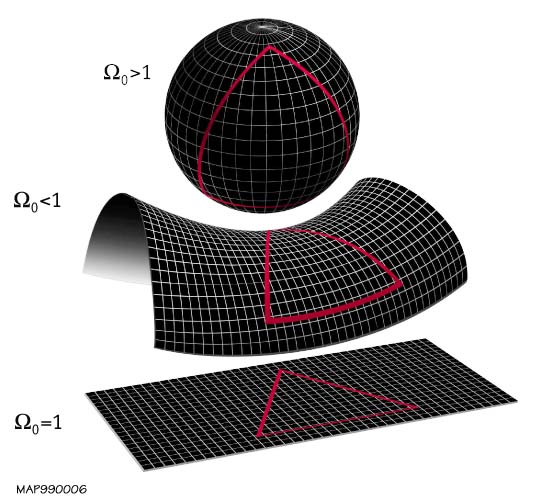
Possible geometries of the universe
So AiG finally came out with a newsletter I felt like responding to. Personally, I don't care if a scientific theory does or doesn't fit with the Bible because I'm not a Bible-truther. However, some people (or organizations) feel the need to mock modern science without understanding it while claiming that it is wrong and disagrees with their book, and thus we should believe their magical story of creation.

A: The “big bang” is a story about how the universe came into existence. It proposes that billions of years ago the universe began in a tiny, infinitely hot and dense point called a singularity. This singularity supposedly contained not only all the mass and energy that would become everything we see today, but also “space” itself. According to the story, the singularity rapidly expanded, spreading out the energy and space.
Not quite. The Big Bang Theory (BBT) doesn't describe the origin of the universe but rather the development of the universe over time. It also doesn't say that the universe was ever point-like. Other than that, I think you're pretty much correct.
It is supposed that over vast periods of time, the energy from the big bang cooled down as the universe expanded. Some of it turned into matter—hydrogen and helium gas. These gases collapsed to form stars and galaxies of stars. Some of the stars created the heavier elements in their core and then exploded, distributing these elements into space. Some of the heavier elements allegedly began to stick together and formed the earth and other planets.
Ok, sure. I have some reading to do on the Nebular hypothesis, but I don't see anything immediately wrong with that summary.
This story of origins is entirely fiction. But sadly, many people claim to believe the big-bang model. It is particularly distressing that many professing Christians have been taken in by the big bang, perhaps without realizing its atheistic underpinnings. They have chosen to reinterpret the plain teachings of Scripture in an attempt to make it mesh with secular beliefs about origins.
Dang, and I was taken in by its scientific underpinnings. I'm pretty sure there's nothing about BBT that requires an atheistic universe. Many creationist organization that aren't AiG have come to embrace the scientific explanation of BBT for how our universe developed. What exactly in the bible is so "contrary" to the idea that all matter initially expanded outwardly to create the universe we have today? Is that not how Yahweh chose to "speak" it into existence? If not, how do you know this? Do you not accept BBT just because your pastor or Sunday school teacher says so (neither of which are authorities on the subject)? (To clarify, not all creationists are Christians. However, only the ones I know are. If you're Muslim, I'm still talking to you.)

I personally believe that Christians are hesitant to accept this theory because it removes their god as a necessity from a universe that has constantly needed less and less supernatural explanation as our knowledge has grown. Christians probably believe this is the one area of science that needs a god to explain it, otherwise we perhaps could have come from "nothing", but this, like the rest of creationism, is just wishful thinking. I'll admit that BBT is tough to understand because there's just so much that goes into it - from complex physical formulas to jargon to Einsteinian relativity. But that's an even better reason to not go around claiming that a certain scientific theory is incorrect when you yourself don't understand it. Leave science to the scientists.

Friday, April 9, 2010

Freedom of Speech

I was waiting at the bus stop just yesterday when I saw a guy about my age reading Ray Comfort's edited version of On the Orgin of Species (which I confess I am disappointed that it shows up on Amazon's top 3 search results). At first I thought to myself, "This is a joke, right? Like, they didn't really make a book with that dumb of an intro, did they?" But of course, they did, and he was reading it. I didn't get to say anything to him about it and if I did I would have told him to just tear out the first few pages and use them as kindle.

What seems sad to me is that, after all these years, Creationists still attack Darwin for his views on... well, the origin of the species. They defame his character as though it matters and as though it has anything to do with what science said then or says today. But the worst part is that a lot of people might notice the book, see the attractive colors, recognize the iconic name, open to the first page, and think that Ray Comfort has actually somehow disproved a grounded scientific theory in under 50 pages. I know, you wouldn't think it's likely, but the odds are good that it would happen to at least a few people. Looking at the cover, you couldn't tell that it is supposed to be a "rebuttal" but it instead somewhat deceptively states that it merely contain an "introduction," which contains some of the poorest argumentation and misunderstanding about the theory I've ever seen.

On one hand, I hate it. In a country with freedom of speech, any uneducated man can publish a book that says anything he wants it to without any legal repercussions. It just doesn't seem fair that it should be published and given to unsuspecting college students throughout the nation. But on the other hand, I love the US for the same reason. Instead of censoring people we don't agree with, we fairly give them the right to voice their side while soundly trouncing every argument they put forth and conclusively showing them to be frauds. Sure, some people might get deceived in the process, but when you consider that it could be you getting shut up by the feds, you realize how important it is that everyone be permitted to at least speak their mind.

Furthermore, you now have the opportunity (perhaps even the responsibility) to become knowledgeable on a subject so that you can better yourself and others by dissecting the lies and showing yourself to be an honest, contributing member of society. I can't count the times I've been thankful for the ability to read an article that my family, friends, government, or politicians wouldn't have wanted me reading. I would hope that in a completely open forum where everyone's voice can be heard, the truth would win out every time.

Tuesday, April 6, 2010

Atheist Blogroll

Rock the Mind has been added to The Atheist Blogroll. You can see the blogroll in my sidebar. The Atheist blogroll is a community building service provided free of charge to Atheist bloggers from around the world. If you would like to join, visit Mojoey at Deep Thoughts for more information.